NO / ENG
TEXTS
1. Cathrine Hovdahl Vik. On Lena Trydals Tell Me What I Want to Hear (2026)
2. Ingrid Halland. Aesthetic Desire in the Age of Surfaces: On Lena Trydal's TAKE OUT (2025)
3. Michael Laundry. On Lena Trydals NEVER FELT LIKE THIS (2025)
4. Geir Haraldseth. On Lena Trydals Folkekongen (2021) and Märtha Louise (2019)
5. Irene Ikdal. On the duo exhibition Nice Paintings & Dead(ly) Fires (2018)
︎︎︎
1.
On Lena Trydals
Tell Me What I Want to Hear (2026)
Original language: Norwegian (translated by ChatGPT)
Exhibition-text for the solo exhibition Tell Me What I Want to Hear, K-U-K Kjøpmannsgata Ung Kunst, March 13. – May 24, 2026
Exhibition page

Chamber (1), 2026. Oil on canvas, 150x200 cm
In a time when images circulate faster than experience, and where reality is often encountered through screens, algorithms, and headlines, Lena Trydal (b. 1994, Kristiansand) examines the role of painting as both mirror and resistance. Her figurative works draw on the visual language of pop and internet culture, where memes, political icons, celebrities, and digital aesthetic codes merge seamlessly into one another.
Trydal’s visual language is closely tied to digital references and the collective aesthetics of the present. Motifs and figures often appear as both intimate and iconic, caught in a liminal space between individual and avatar, original and copy. The paintings point to how identity and power are not only constructed through language and politics, but also through images: through which faces are repeated, which narratives are amplified, and which visual codes become normative. Trydal does not merely paint the images of the present; she paints the way the present sees.
In the solo exhibition Tell Me What I Want to Hear, Trydal engages with international politics, popular culture, and power dynamics as concurrent visual regimes. The title can be read as an imperative—a demand for confirmation and loyalty—but also as an expression of affective vulnerability: a desire for comforting narratives within a fragmented and information-saturated public sphere. Between these poles, a space emerges in which Trydal’s paintings operate—a space where irony, ambivalence, and critique coexist with humor and visual seduction. Within this tension between authority and longing, the works articulate a critique of contemporary media logic, where truth is often subordinated to the attention economy and affective resonance.
The motifs move between the iconic and the trivial, between political figures, celebrities, and everyday gestures. In this way, Trydal engages with what the French sociologist and philosopher Jean Baudrillard describes in Simulacra and Simulation (1981). This philosophical treatise examines the relationship between reality, symbols, and society, particularly the role of culture and media in constructing a shared sense of existence. Here, representations no longer point to a stable referent, but circulate as self-referential signs. At the same time, the works point to how images function as technologies of power, in line with theories of visual culture and biopolitics, where visibility and invisibility shape who is granted subjecthood and who is marginalized.
By painting these images, Trydal foregrounds painting as a critical technology. Where the digital image stream is characterized by acceleration, fragmentation, and algorithmic curation, painting introduces a different temporality: a time for contemplation, for resisting immediate consumption. Here, painting functions as a slow gesture within a hyper-accelerated visual culture—a space where the political and affective charge of images can be examined and destabilized.
Tell Me What I Want to Hear invites the viewer to reflect on how we consume information, how we relate to power, and how we are shaped by the images that surround us. The exhibition raises questions about who tells the stories, who becomes visible, and which versions of reality we choose to believe—and which we want to hear.
Trydal’s visual language is closely tied to digital references and the collective aesthetics of the present. Motifs and figures often appear as both intimate and iconic, caught in a liminal space between individual and avatar, original and copy. The paintings point to how identity and power are not only constructed through language and politics, but also through images: through which faces are repeated, which narratives are amplified, and which visual codes become normative. Trydal does not merely paint the images of the present; she paints the way the present sees.
In the solo exhibition Tell Me What I Want to Hear, Trydal engages with international politics, popular culture, and power dynamics as concurrent visual regimes. The title can be read as an imperative—a demand for confirmation and loyalty—but also as an expression of affective vulnerability: a desire for comforting narratives within a fragmented and information-saturated public sphere. Between these poles, a space emerges in which Trydal’s paintings operate—a space where irony, ambivalence, and critique coexist with humor and visual seduction. Within this tension between authority and longing, the works articulate a critique of contemporary media logic, where truth is often subordinated to the attention economy and affective resonance.
The motifs move between the iconic and the trivial, between political figures, celebrities, and everyday gestures. In this way, Trydal engages with what the French sociologist and philosopher Jean Baudrillard describes in Simulacra and Simulation (1981). This philosophical treatise examines the relationship between reality, symbols, and society, particularly the role of culture and media in constructing a shared sense of existence. Here, representations no longer point to a stable referent, but circulate as self-referential signs. At the same time, the works point to how images function as technologies of power, in line with theories of visual culture and biopolitics, where visibility and invisibility shape who is granted subjecthood and who is marginalized.
By painting these images, Trydal foregrounds painting as a critical technology. Where the digital image stream is characterized by acceleration, fragmentation, and algorithmic curation, painting introduces a different temporality: a time for contemplation, for resisting immediate consumption. Here, painting functions as a slow gesture within a hyper-accelerated visual culture—a space where the political and affective charge of images can be examined and destabilized.
Tell Me What I Want to Hear invites the viewer to reflect on how we consume information, how we relate to power, and how we are shaped by the images that surround us. The exhibition raises questions about who tells the stories, who becomes visible, and which versions of reality we choose to believe—and which we want to hear.
2.
Aesthetic Desire in the Age of Surfaces:
On Lena Trydal's TAKE OUT (2025)
Original language: Norwegian (translated by the author)
Exhibition-text for the solo exhibition TAKE OUT, Statsbygg, Møllergata 13b, September 12. - December 21, 2025
Exhibition page
I. Softer
The saying “you are what you eat” takes on a different meaning when considering the biological evolution of humankind. The human species Homo Erectus mastered the use of fire—through skills such as planning and calculation—and then began to cook meat, fish, and roots. The food became softer, and the jaws smaller, allowing the brains to grow and new neurons to form. By cooking food, digestion began outside the body. Consequently, stomachs became smaller, and Homo Sapiens could walk upright more easily and even run. Less energy was needed for the gut system, freeing up more energy for the growing brain. The food we ate made us who we are.
In 2025, the journal Appetite published results from a study on junk food. The Norwegian research team fed female rats a junk food diet for six weeks and studied changes in their neuroactivity. The junk food weakened the rats’ appetite for natural rewards, including the desire for sexual activity. The researchers argue that thick kebab sauce, greasy burgers, and soft, factory-baked bread contribute to slowing down reproductive drive. A consequence of a lower sexual drive for the human species would be changes in the biological development of humankind. In this context, “you are what you eat” would take on a more literal meaning than before..
II. More Similar
Throughout human history, aesthetics has been linked to communication, power, and identity. What might first seem superficial or decorative can reveal complex and often powerful cultural and historical identities. Whether it concerns the ornamentation on a ceramic vase, jewelry, or tattoos, aesthetic expressions and practices have either created a sense of belonging or expressed individual identity. But aesthetics can also serve the opposite purpose—alienating cultures and individuals from others.
Aesthetic has played a central role in the development of consumer society. In the 1920s, the American Edward Bernays, Sigmund Freud’s nephew, laid the groundwork for a new phase in this development. Bernays developed his uncle’s theories of human desires to connect shopping with a sense of well-being. He exploited a fundamental human drive—aesthetic desire—to manipulate the masses into buying things they didn’t really need, to fill their individual craving for pleasure while also meeting capitalism’s structural need for growth. Throughout the 20th century, beauty and aesthetics became increasingly linked to makeup and beauty products. In the last five decades, Western consumer society has cultivated an aesthetic culture where trends change rapidly. However, aesthetic expressions have become increasingly less individual. Products, faces, and desires have become more uniform and similar to each other.
III. Deeper
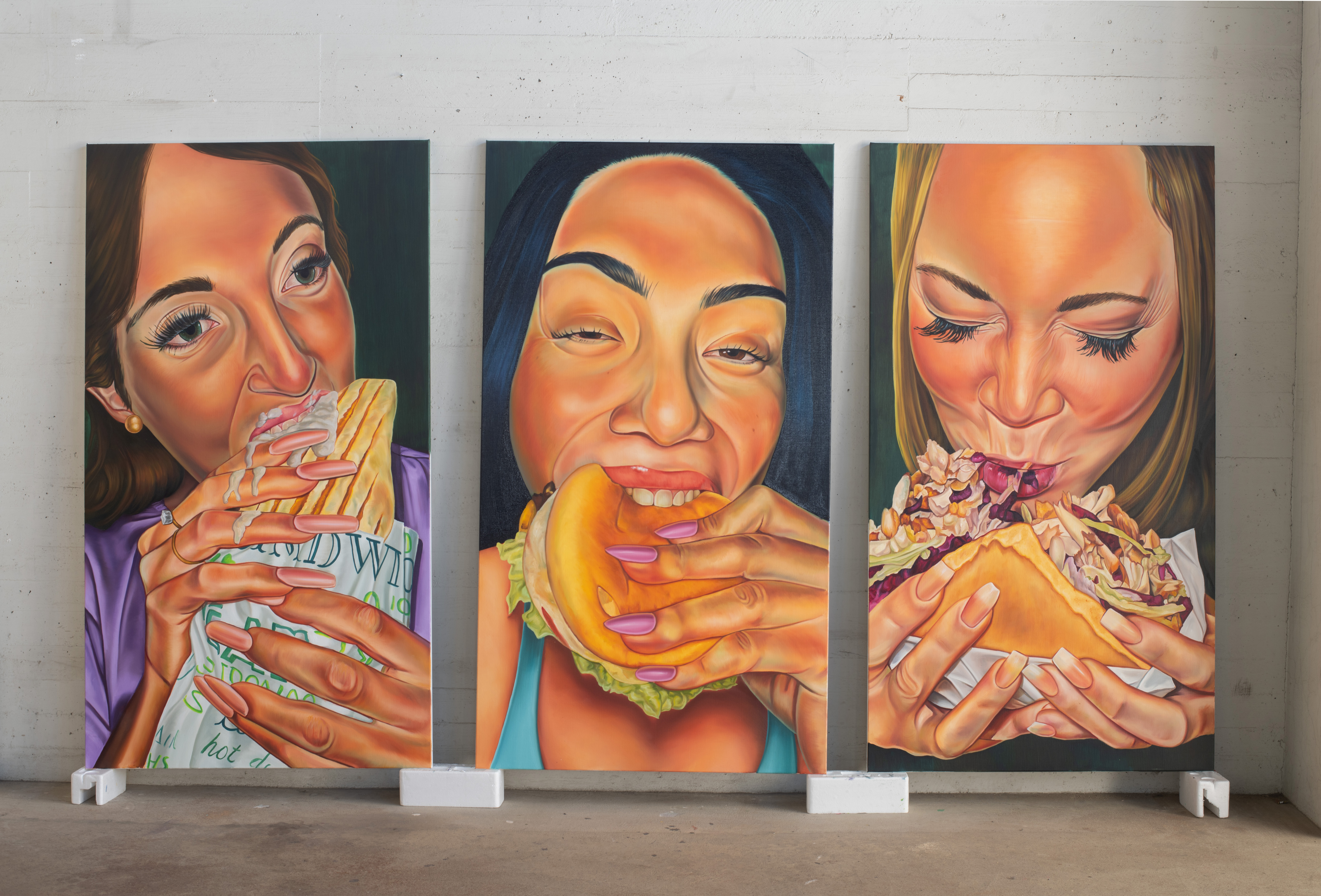
In the painting series TAKE OUT (2025), Lena Trydal explores the aesthetics of desire in our time. Since her debut in the public scene in 2022, she has showcased uncomfortable, humorous, and strange aspects of Western mass culture through a distinctive visual language rooted in the classical Western figurative painting tradition. However, both her approach and formal expression break from the classical, drawing inspiration primarily from Google Images (e.g., Royalty Free Stock Images) and by swiping and scrolling through our contemporary visual mass culture on TikTok or Instagram. Trydal’s paintings often depict figures posing for the gaze of the masses. In TAKE OUT, three female figures appear in a climax moment, surrendering to the irresistibility of junkfood. Their lip-gloss shimmer and food fat drips over their gel nails. The women’s eyes—framed by false lashes and brows styled with brow lamination techniques—reveal the intense pleasure of giving in to temptation. Yet, their almost animalistic desire isn’t solely directed at the ultra-processed food. The three women also desire the beholder’s gaze. The rectangular shape of the canvases reflects the screens they pose for. They desire their own mirror image and they crave the digital gazes just as intensely as they desire the soft food.
Western art history is deeply rooted in the divide between form and content: ‘Form’ refers to the style, techniques, media, and materials of the artwork, while ‘content’ refers to the representation or mimesis—what is depicted. Trydal engages in dialogue with Western art history by portraying figures in a figurative and realistic style. Throughout art history, realism has been expressed in various ways, but a common trait of realistic style is that human figures are neither stylized nor idealized; they are meant to convey the unique and distinctive traits of the figures. However, Trydal’s three female figures have relatively few distinctive features to highlight individuality. Although the paintings depict three different women, their similarity is striking; they use the same contouring techniques for makeup, have equally straight, white teeth, and all have sleek, blow-dried hair—a sort of assembly-line aesthetic.
It’s not just the content of the paintings that refers to the superficial and uniform aspects of contemporary mass culture. For Trydal, figurative painting itself is associated with mass culture. And within the hierarchies of contemporary art—a low culture. Additionally, Trydal emphasizes the painting’s characteristics as a flattening medium through techniques that reflect the interplay between flatness and uniformity in Western popular culture. The figurative motifs and painterly execution might initially seem trivial, but Trydal’s visual universe has a complex conceptual context embedded within the surface medium. Trydal often uses classical glazing techniques to soften or enhance colors, almost like a setting spray in ‘soft contouring’ makeup. She highlights some colors and blends others, so the canvas surface resembles an airbrush filter. Often, it is contour powder, highlighter, and flash lighting that adds life and glow to the figures’ faces, not natural daylight. In Trydal’s visual universe, figure and surface—and thereby form and content—become increasingly similar.
As a sort of coda to the TAKE OUT series, Prêt-à-Manger (Triple) (2024) stands alone. Three open white containers with fries, ketchup, and fried chicken float in an undefined, blue-green sphere. Our ancestors tamed fire, changed their way of eating, and in doing so, changed themselves. Today, additives, sugar, and fats have been linked to changes in brain chemistry, metabolism, and even genetics over time. By placing the plastic containers in this blue-green, indefinable space—like a digital or virtual landscape—Trydal reminds us that Western consumer culture is increasingly detached from biological roots, building instead on mediated, manipulated stimuli. Liberally, full of humor, and without moral judgments, Trydal’s TAKE OUT depicts what is deeply human in the age of surfaces.
The saying “you are what you eat” takes on a different meaning when considering the biological evolution of humankind. The human species Homo Erectus mastered the use of fire—through skills such as planning and calculation—and then began to cook meat, fish, and roots. The food became softer, and the jaws smaller, allowing the brains to grow and new neurons to form. By cooking food, digestion began outside the body. Consequently, stomachs became smaller, and Homo Sapiens could walk upright more easily and even run. Less energy was needed for the gut system, freeing up more energy for the growing brain. The food we ate made us who we are.
In 2025, the journal Appetite published results from a study on junk food. The Norwegian research team fed female rats a junk food diet for six weeks and studied changes in their neuroactivity. The junk food weakened the rats’ appetite for natural rewards, including the desire for sexual activity. The researchers argue that thick kebab sauce, greasy burgers, and soft, factory-baked bread contribute to slowing down reproductive drive. A consequence of a lower sexual drive for the human species would be changes in the biological development of humankind. In this context, “you are what you eat” would take on a more literal meaning than before..
II. More Similar
Throughout human history, aesthetics has been linked to communication, power, and identity. What might first seem superficial or decorative can reveal complex and often powerful cultural and historical identities. Whether it concerns the ornamentation on a ceramic vase, jewelry, or tattoos, aesthetic expressions and practices have either created a sense of belonging or expressed individual identity. But aesthetics can also serve the opposite purpose—alienating cultures and individuals from others.
Aesthetic has played a central role in the development of consumer society. In the 1920s, the American Edward Bernays, Sigmund Freud’s nephew, laid the groundwork for a new phase in this development. Bernays developed his uncle’s theories of human desires to connect shopping with a sense of well-being. He exploited a fundamental human drive—aesthetic desire—to manipulate the masses into buying things they didn’t really need, to fill their individual craving for pleasure while also meeting capitalism’s structural need for growth. Throughout the 20th century, beauty and aesthetics became increasingly linked to makeup and beauty products. In the last five decades, Western consumer society has cultivated an aesthetic culture where trends change rapidly. However, aesthetic expressions have become increasingly less individual. Products, faces, and desires have become more uniform and similar to each other.
III. Deeper
In the painting series TAKE OUT (2025), Lena Trydal explores the aesthetics of desire in our time. Since her debut in the public scene in 2022, she has showcased uncomfortable, humorous, and strange aspects of Western mass culture through a distinctive visual language rooted in the classical Western figurative painting tradition. However, both her approach and formal expression break from the classical, drawing inspiration primarily from Google Images (e.g., Royalty Free Stock Images) and by swiping and scrolling through our contemporary visual mass culture on TikTok or Instagram. Trydal’s paintings often depict figures posing for the gaze of the masses. In TAKE OUT, three female figures appear in a climax moment, surrendering to the irresistibility of junkfood. Their lip-gloss shimmer and food fat drips over their gel nails. The women’s eyes—framed by false lashes and brows styled with brow lamination techniques—reveal the intense pleasure of giving in to temptation. Yet, their almost animalistic desire isn’t solely directed at the ultra-processed food. The three women also desire the beholder’s gaze. The rectangular shape of the canvases reflects the screens they pose for. They desire their own mirror image and they crave the digital gazes just as intensely as they desire the soft food.
Western art history is deeply rooted in the divide between form and content: ‘Form’ refers to the style, techniques, media, and materials of the artwork, while ‘content’ refers to the representation or mimesis—what is depicted. Trydal engages in dialogue with Western art history by portraying figures in a figurative and realistic style. Throughout art history, realism has been expressed in various ways, but a common trait of realistic style is that human figures are neither stylized nor idealized; they are meant to convey the unique and distinctive traits of the figures. However, Trydal’s three female figures have relatively few distinctive features to highlight individuality. Although the paintings depict three different women, their similarity is striking; they use the same contouring techniques for makeup, have equally straight, white teeth, and all have sleek, blow-dried hair—a sort of assembly-line aesthetic.
It’s not just the content of the paintings that refers to the superficial and uniform aspects of contemporary mass culture. For Trydal, figurative painting itself is associated with mass culture. And within the hierarchies of contemporary art—a low culture. Additionally, Trydal emphasizes the painting’s characteristics as a flattening medium through techniques that reflect the interplay between flatness and uniformity in Western popular culture. The figurative motifs and painterly execution might initially seem trivial, but Trydal’s visual universe has a complex conceptual context embedded within the surface medium. Trydal often uses classical glazing techniques to soften or enhance colors, almost like a setting spray in ‘soft contouring’ makeup. She highlights some colors and blends others, so the canvas surface resembles an airbrush filter. Often, it is contour powder, highlighter, and flash lighting that adds life and glow to the figures’ faces, not natural daylight. In Trydal’s visual universe, figure and surface—and thereby form and content—become increasingly similar.
As a sort of coda to the TAKE OUT series, Prêt-à-Manger (Triple) (2024) stands alone. Three open white containers with fries, ketchup, and fried chicken float in an undefined, blue-green sphere. Our ancestors tamed fire, changed their way of eating, and in doing so, changed themselves. Today, additives, sugar, and fats have been linked to changes in brain chemistry, metabolism, and even genetics over time. By placing the plastic containers in this blue-green, indefinable space—like a digital or virtual landscape—Trydal reminds us that Western consumer culture is increasingly detached from biological roots, building instead on mediated, manipulated stimuli. Liberally, full of humor, and without moral judgments, Trydal’s TAKE OUT depicts what is deeply human in the age of surfaces.
3.
.
On Lena Trydals
NEVER FELT LIKE THIS (2025)
Original language: English
Exhibition-text for the solo exhibition NEVER FELT LIKE THIS, Mikey Laundry Art Garden, August 8-31, 2025
Exhibition page

Each year MLAG is curated thematically. This year we discuss the theme `heavy in love´ after French Sociologist Roland Barthes´ A Lover´s Discourse. The book is a collection of fragments about love from Plato, Nietzche, and Goethe published in 1977. In the preface, Barthes tells us that “the lover's discourse of today is one of an extreme solitude”. Being in love is isolating on many levels. Almost 50 years later, the state of love, finding it, and our feelings toward it - are in a state of alienation. Lena Trydal’s ‘Never Felt Like This’ presents work interrogating Barthes’ assumptions. Barthes argues that love is “forsaken”, “disparaged, or derided” by the realm of natural and social sciences. But Barthes suggests love is an “unreal” thing that is nonetheless still affirmed.
Love´s affirmation as a subject, a driver, and an adversario has been taken up by artists since the first cave paintings and continues to pose conundrums at MLAG. But what is it about love`s mediation in today´s frenzied and confident pop culture media landscape that makes it something needing to be navigated? … something to be mistrusted yet kind of affirmed? Lena Trydal´s series of oil paintings on stretched canvas parlays as lover´s do with what Barthes calls the “unreal” of the language of love - when the mechanisms of our rational faculties fail us and we still affirm love´s authenticity.
Trydal plums the world of reality TV shows and royalty-free stock images from the net,checking back in with the “unreal”. The process might be likened to found object art - where Trydal is the wizard tossing our readymade referencescape for a loop. In her own words, “the world of reality-TV and shows such as Love is Blind, Love Island, Married at First Sight, The Ultimatum and Perfect Match—a realm brimming with red roses, cheesy pickup lines, diamond rings, and clichéd gender norms”, these are the subjects and objects of aesthetic study. What story do they tell when appropriated by Trydal - whisked out into the public gaze again, sultry, still dressed up - yet naked.
One possible way of seeing the evolution of the readymade is to see it as a movement pushing back against capitalism’s demand for growth. Trydal’s series of figurative paintings are no upside down urinals, yet in a post-Duchamp world we see objects differently - aesthetically, we see their relational potential more than we did before. Hal Foster - the old Princeton professor of Art History was freaked out by a younger generation of figurative painters since the 70’s. He worried that if the paintings weren’t meta-artistic - if they failed to have a critical self-referentiality - their appropriation of culture risks becoming spectacle. Trydal’s disruption of the everydayness of finding love does as Robert Grober and Cindy Sherman have done before her - make art make us step-outside of our assumptions about what has come before us. Trydal’s painting’s sometimes imitate the selected source yet, their power is in the evidence of the artist’s hand. It draws our attention to the question of making. In elevating low culture, the artist returns to the conversation of "art-as-simulacrum", asking what the simulation substantiates?
Trydal’s exhibition is full of paradoxes and the disenchantment of proximity. The act of drawing us closer to the hyper-detailed has the surprising effect of bringing us further away from its intended symbolism, zooming further and furher out, deepening our relationship to the superficial painted back upon itself.
Love´s affirmation as a subject, a driver, and an adversario has been taken up by artists since the first cave paintings and continues to pose conundrums at MLAG. But what is it about love`s mediation in today´s frenzied and confident pop culture media landscape that makes it something needing to be navigated? … something to be mistrusted yet kind of affirmed? Lena Trydal´s series of oil paintings on stretched canvas parlays as lover´s do with what Barthes calls the “unreal” of the language of love - when the mechanisms of our rational faculties fail us and we still affirm love´s authenticity.
Trydal plums the world of reality TV shows and royalty-free stock images from the net,checking back in with the “unreal”. The process might be likened to found object art - where Trydal is the wizard tossing our readymade referencescape for a loop. In her own words, “the world of reality-TV and shows such as Love is Blind, Love Island, Married at First Sight, The Ultimatum and Perfect Match—a realm brimming with red roses, cheesy pickup lines, diamond rings, and clichéd gender norms”, these are the subjects and objects of aesthetic study. What story do they tell when appropriated by Trydal - whisked out into the public gaze again, sultry, still dressed up - yet naked.
One possible way of seeing the evolution of the readymade is to see it as a movement pushing back against capitalism’s demand for growth. Trydal’s series of figurative paintings are no upside down urinals, yet in a post-Duchamp world we see objects differently - aesthetically, we see their relational potential more than we did before. Hal Foster - the old Princeton professor of Art History was freaked out by a younger generation of figurative painters since the 70’s. He worried that if the paintings weren’t meta-artistic - if they failed to have a critical self-referentiality - their appropriation of culture risks becoming spectacle. Trydal’s disruption of the everydayness of finding love does as Robert Grober and Cindy Sherman have done before her - make art make us step-outside of our assumptions about what has come before us. Trydal’s painting’s sometimes imitate the selected source yet, their power is in the evidence of the artist’s hand. It draws our attention to the question of making. In elevating low culture, the artist returns to the conversation of "art-as-simulacrum", asking what the simulation substantiates?
Trydal’s exhibition is full of paradoxes and the disenchantment of proximity. The act of drawing us closer to the hyper-detailed has the surprising effect of bringing us further away from its intended symbolism, zooming further and furher out, deepening our relationship to the superficial painted back upon itself.
4.
On Lena Trydals
Folkekongen (2021) and Märtha Louise (2019)
Artwork-text for the group exhibition I Call It Art, The National Museum of Art, Architecture and Design, June 11. - September 11, 2022
Exhibition page
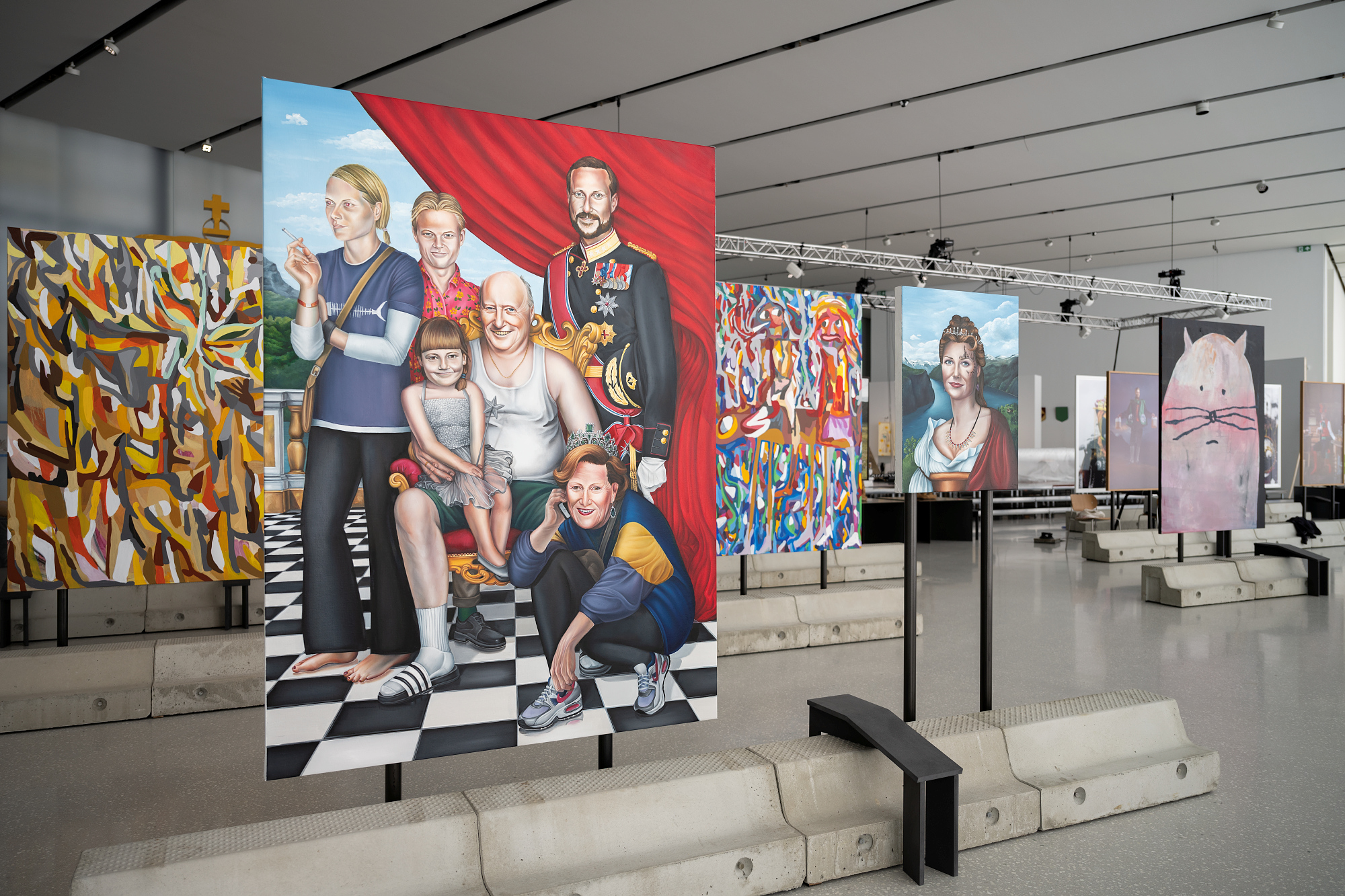
Portraits of the rich and powerful have always featured heavily in art, but today the genre may seem outdated and not as popular. Lena Trydal’s paintings test the boundaries of what a portrait can be in our modern age. The two paintings of hers we are showing at the exhibition are undoubtedly edgy and full of humour. A large portrait of the Norwegian royal family shows a relaxed king who has not dressed up for the occasion. The only one taking the portrait seriously is the crown prince, while the queen is chilling on her phone. The crown prince’s sister, Princess Märtha Louise, has always done things her own way and is here portrayed in her own painting, next to Folkekongen (‘the people’s king’). How far can the royal family go in their desire to be down-to-earth and accessible?
Trydal paints figuratively and explores various genres from the history of painting, even as she seeks to say something about the world today. In addition to the royal family, Trydal has portrayed political figures such as Donald Trump and Vladimir Putin in new situations. What is magical about painting is that everything is allowed. Trydal is calling the shots here.
Trydal paints figuratively and explores various genres from the history of painting, even as she seeks to say something about the world today. In addition to the royal family, Trydal has portrayed political figures such as Donald Trump and Vladimir Putin in new situations. What is magical about painting is that everything is allowed. Trydal is calling the shots here.
5.
On the duo exhibition
Nice Paintings & Dead(ly) Fires (2018)
Original language: Norwegian (translated by ChatGPT)
Exhibition text for the duo exhibition Nice Paintings & Dead (ly) Fires, Arteriet, September 7. - October 7, 2018

The group exhibition Nice Paintings & Dead(ly) Fires presents the work of two young female artists: Lena Trydal (b. 1994, Kristiansand) and Thyra Dragseth (b. 1993, Copenhagen). The exhibition brings together two distinct artistic practices. While each body of work can be experienced independently, it feels more rewarding to explore the dialogue between them within a broader context.
The challenge lies in navigating an exhibition in which several points of entry share common threads. Even the title raises intriguing questions. Are Trydal's oil paintings really "nice"? How does Dragseth portray the deadly progression of fire? On a purely technical level, Dragseth's video installation In Search of Dead(ly) Fires and Trydal's Nice Paintingsforeground the material qualities of their respective media. The temporal and sonic dimensions of video, as well as painting's illusions created through light and pigment, are essential to their artistic expression. Yet it is only through the encounter with the viewer that the video installation and paintings cease to be neutral or passive objects. Seen through the perspective of a younger generation, the works open up alternative ways of perceiving the world around us.
At the time of writing, both Trydal and Dragseth are in their twenties, born just one year apart and studying respectively at the University of Oslo and the Oslo National Academy of the Arts. They belong to the millennial generation, navigating a complex world shaped by rapid social and political change: globalization, social media, climate change, questions of gender, and growing awareness of mental health. Against this backdrop, the exhibition reveals how the artists' personal experiences intersect with an active engagement with contemporary society.
THYRA DRAGSETH
In Search of Dead(ly) Fires (2017–18) is a video installation comprising five projections accompanied by a single audio track. The projections are arranged so that it is impossible to view all of them simultaneously. The sequences depict a motorcycle ride, a forest landscape, charred objects crushed by a hand wearing a black glove, a dead dolphin, and a camera circling a young man.
The installation was inspired by Dragseth's exchange residency at the Faculty of Fine Arts (Belas Artes), University of Lisbon. Its title refers to the devastating wildfires that swept through Portugal in 2017, claiming more than sixty lives. The work stages this tragedy through a poetic and seductive visual language, while continually confronting the viewer with the harsh realities of a landscape marked by destruction.
Dragseth establishes a connection between fiction and a real historical event, yet uncertainty arises precisely when we lose visual control of the situation. We move between images of humanity's fragile relationship with nature and the body of a young man subjected to the gaze of others. The latter not only reveals how art can expose gendered structures of power, but also reflects on the significance of occupying the position of a female artist.
LENA TRYDAL
Trydal's vividly coloured oil paintings suggest references to reality through acute observation, surreal details, and rigorously constructed compositions. Nice Paintings, however, demands a position beyond purely aesthetic appreciation. On an aesthetic level, it matters little whether the paintings correspond to factual reality or fiction; on an ethical level, however, this distinction becomes crucial.
The paintings depict subjects such as a woman dressed in a traditional Norwegian bunad with her face concealed by a niqab (Yes, We Love #2, 2015), a smiling nude girl holding the trigger attached to a suicide vest (I Just Wanted Something to Believe In, 2016), and King Harald V seated with the royal family wearing thermal underwear while Queen Sonja crouches at the bottom of the composition (The People's King, 2017–18).
The contradictions embedded within these images push our social and political norms to their limits. What unsettles us is the question of whether we should interpret the paintings literally or symbolically. As objects, the paintings maintain a certain distance from the cultural conflicts they evoke, yet they also demand our closer engagement if these disturbing images are to acquire meaning. It is paradoxical that their psychodramatic subject matter is simultaneously attractive and repellent. The ambiguity of the imagery thus sustains both an ethical distance and an empathetic proximity.
The Art of Contradictions
The works of Trydal and Dragseth balance a series of oppositions: nature and culture, fiction and reality, good and evil, woman and man, subject and object. It is important to stress that neither side of these binaries is presented as more truthful or authentic than the other. This delicate balancing act creates space for artistic expressions that resist fixed points of reference. At the same time, the encounter between aesthetics and pressing social and political concerns demonstrates that this younger generation of artists is deeply invested in exploring the ethical potential of contemporary art.
︎ lenatrydal
︎ lenatrydal(at)proton.me
︎ join the mailing list
All rights reserved ©Lena Trydal/BONO